Showing posts with label injuries. Show all posts

Wednesday, May 19, 2010

Torn Rotator Cuff


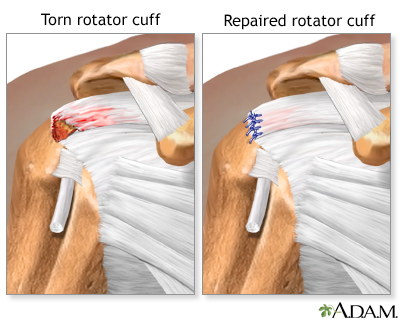
The rotator cuff is a group of muscles and tendons that help to stabilize the shoulder. One or more tendons may become inflamed due to overuse, age, falling or collision. Sports requiring extensive, repeated use of the shoulder have more injuries to the rotator cuff. The injury most often happens to pitchers and quarterbacks because they throw the ball countless times not only during the game but during the week as well.

Signs
Somebody who has an injury to their rotator cuff will likely complain of pain in their deltoid muscle and outer shoulder, especially when the arm is raised in front of them, or out to the side. The shoulder may feel weak, especially when trying to lift the arm into a horizontal position. The athlete may hear a clicking or popping sound in their shoulder when it moves.

How is it diagnosed?
Pain or weakness on an inward or outward rotation of the arm may indicate a torn rotator cuff. There may also be pain when the arm is lowered to the side after the shoulder is moved back and the arm is raised. The problem is that with torn rotator cuffs, you can't look at an X-ray and tell. The shoulder may appear normal. In order to fully detect a torn rotator cuff, an MRI needs to be done, but even that does not detect partial tears.

Treatment
If bad enough, Tommy John surgery may need to be done. However, most times, it is possible to get away with putting heat and ice on teh shoulder and wearing it in a sling for a few days. Other treatments may be done like electrical stimulation, ultrasound or cortisone shots.

On a semi-side note, Tommy John surgery is named after the baseball pitcher, Tommy John, who was the first pitcher to have surgery done to repair his torn rotator cuff. He had 288 victories, the most for any pitcher not selected for the Hall of Fame. He has the 7th highest number of wins for any left-handed pitcher. He made his major league debut for the Cleveland Indians in 1963 and went on to play for the Chicago White Sox, Los Angeles Dodgers, New York Yankees, California Angels, Oakland Athletics and back to the Yankees before he retired in 1989. He had surgery on September 25, 1974.

Friday, April 23, 2010

Injuries and Statistics

According to the U.S. Consumer Product Safety Commission Report, sports injuries in baby boomers increased by 31 percent from 1991 to 1998. About 276,000 emergency room cases were for people aged 35-54 in 1991. In 1998, that number skyrocketed to 365,000. In 2006, the NEISS (National Electronic Injury Surveillance System) reported over half a million injuries associated with basketball alone.

Baby boomers suffered over 1 million sports related injuries, which ended up costing $18.7 billion in medical costs in 1998.

Basketball is the sport with the highest number of injuries. I didn't realize there weren't hat many injuries associated basketball. It makes sense though, between the colliding and the jumping involved with basketball, there is a high possibility of injury. One might think that football and lacrosse and other contact sports would be right up there. They are, but you have to remember when thinking about this issue, that with lacrosse, football, etc. the players are wearing pads. In basketball, they aren't.

I've looked, but I couldn't find any statistics about rugby. On this website rugby is combined with lacrosse, and they had relatively few injuries, but I think that that would be a sport that is pretty high as well. There is all of the intense contact of soccer and football, all the collisions, but no padding like in football. I guess I'll just always wonder.

NEISS put out predictions based on 2006 data. Here is what they said

bold=sport
italics=number of projected injuries

Basketball-529,837 These injuries are mainly cut hands, sprained ankles, broken legs, eye and forehead injuries
Bicycling-490,434 These injuries are mainly feet caught in spokes, head injuries from falls, slipping while carrying bicycles, collisions with cars
Football-460,210 These injuries are mainly fractured wrists, chipped teeth, neck strains, head lacerations, dislocated hips and jammed fingers
ATV's, Mopeds, Minibikes-257,123 Riders of ATV's were injured when they thrown. Along with this there were also fractured wrists, dislocated hands, shoulder sprains, head cuts and lumbar strains
Baseball, Softball-274,867 These injuries were mainly head injuries from bats and balls or ankle injuries from running bases or sliding into them
Exercise, Exercise Equipment-269,249 These injuries were mainly twisted ankles and cut chins from tripping on treadmills. Head injuries from falling backward from exercise balls, ankle sprains from jumping rope
Soccer-196,544 This injuries were mainly twisted ankles or knees after falls, fractured arms during games
Swimming-164,607 The injuries were mainly head injuries from hitting the bottom of pools, and leg injuries from accidentally falling into pools
Skiing, Snowboarding-96,119 These injuries were mainly head injuries from falling, cut legs and faces, sprained knees or shoulders
Lacrosse, Rugby-85,580 These injuries were mainly head and facial cuts from getting hit by balls and sticks, injured ankles from falls

This is a comparison of injuries associated with 16 popular sports between 1991 and 1998.


http://www.scientificpsychic.com/fitness/sport_injuries.html

Friday, March 12, 2010

IC Training Room

I went over to teh Training Room today. I spoke to Chris Hummel. By an extreme amount of good luck, he happens to be the Athletic Trainer for the Ithaca College Gymnastics team. Good luck, right? I told you. So, I asked him questions about what the common injuries were in gymnastics and he gave me a list of five. They are:
  • Tibia Stress Fractures
  • Ankle Sprains
  • Stress Fractures in the Lumbar Spine (Spondylysis, commonly called "Spondy")
  • ACL injuries
  • Concussions
I then asked him what some of the common prevention methods that he uses are. He said:
  • Educating the athletes on the possible injuries and informing them of issues with them, etc.
  • Having them come in as soon as possible, if they have any early signs, meet with an Athletic Trainer
  • Talking with an Athletic Trainer about the history of their injuries
  • Strengthening as far as ankle injuries go
  • Mechanics of jumping and landing with an ACL injury
I asked him when I could go and learn some basic taping techniques. They are open 9-12 Monday through Friday and between 2:30 and 8 pm. He said those were the best times. In the morning they are the least busy and in the afternon, they are the busiest. He also sent me to an online reference that I can use. I can use the Journal of Athletic Training. It is an online magazine that I can use. The volume that he sent me to has statistics about a lot of college sports and the injuries that they involve. I'll blog about this later when I read up on it.

That's it for now...

Wednesday, February 3, 2010

Dear Reader

Dear Reader,

For my WISE project, I plan to shadow Kim Baily, Ithaca High School's Athletic Trainer. By the end of the semester, I want to have a diagram and be able to show the major injuries sustained in gymnastics. I want to know how to take care of the injury and prevent it from happening again. For your reference, I am going to Ithaca College next year to study Athletic Training.

I am really excited about starting my project. I have talked to an Athletic Trainer at Ithaca College and he said that I should learn the basics. By this, I mean get my taping skills better and learn how to spot. I'm nervous about getting as much done as I want to get done. There is going to be a large amount of research involved in this project, and I'm worried about putting it off until the last minute.

For the next two weeks, I am not going to be able to do a whole lot because I have a lot to do with dance, but I am going to start meeting with Kim two to three times a week and asking her questions. I could go up to Ithaca College and spend time in the Training Room. After I learn what the major injuries are, I could start doing the research on them.

For Now,
Taylor Dyess